
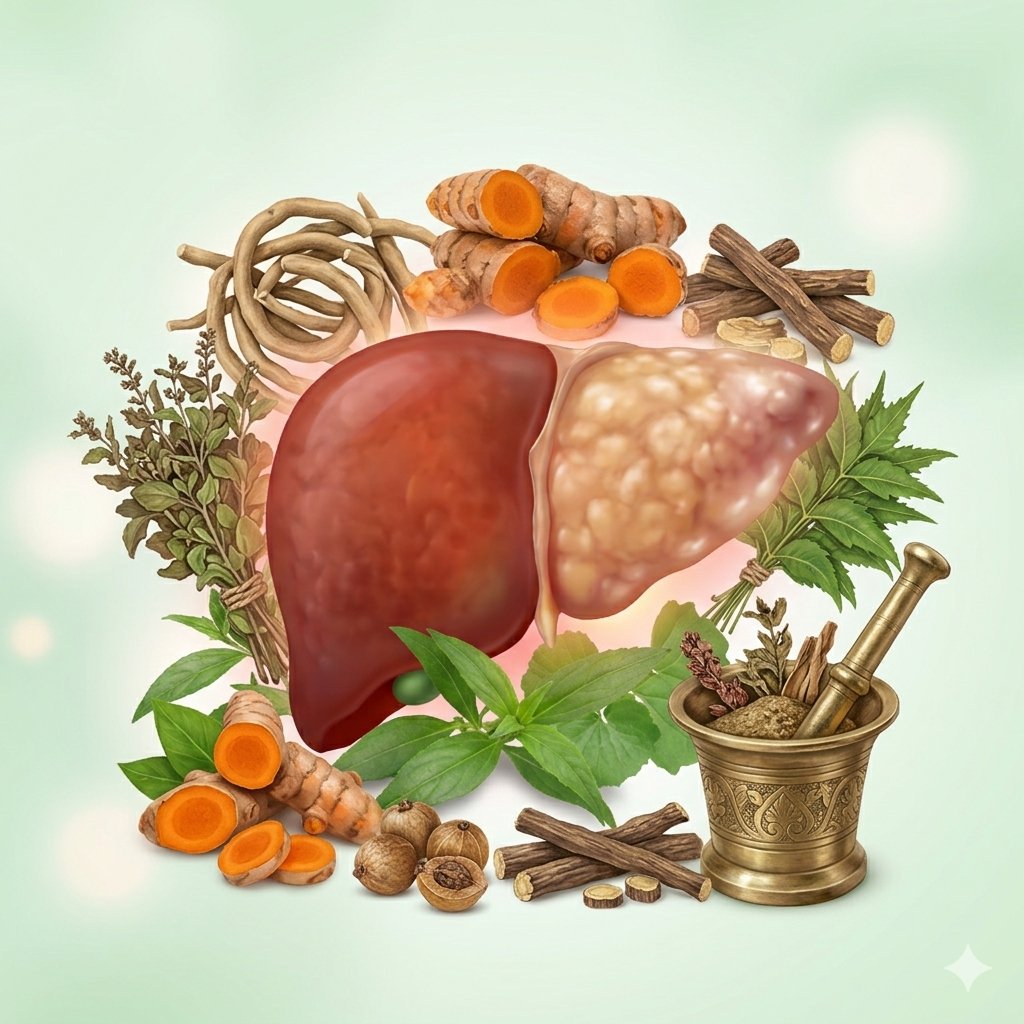
Quick answer
Ayurvedic treatment for fatty liver aims to restore digestion and metabolism (Agni) and reduce excess Kapha and fat (Meda) that settle in the liver (Yakrit). It combines a Pathya diet, a daily routine with yoga and activity, and individually prescribed herbs. Diet, weight loss and exercise remain the proven foundation. Herbs such as turmeric show modest benefits in small studies, and some — like giloy and ashwagandha — have rare liver-injury reports. At Dr. Monga Medi Clinic, Ayurvedic treatment is always monitored with liver tests.
Key takeaways
- Ayurveda sees fatty liver as an over-nourishment disorder (Santarpanajanya) of Kapha–Meda in the liver — a close match to modern insulin resistance.
- The most effective Ayurvedic tools are also lifestyle tools: Pathya diet, Dinacharya and yoga.
- Among herbs, turmeric/curcumin has the most trial data, with modest falls in liver enzymes.
- Herbal does not always mean safe: giloy and ashwagandha have liver-injury reports, so take herbs only on prescription.
- Follow WHO limits: free sugar under 10% of calories, salt under 5 g, 150–300 minutes of activity a week, no alcohol.
01What is Ayurvedic treatment for fatty liver?
Short answerAyurvedic treatment for fatty liver is a personalised plan that corrects digestion and metabolism (Agni), reduces excess Kapha and body fat (Meda), and protects the liver (Yakrit). It uses diet (Pathya), daily routine (Dinacharya), yoga and prescribed herbs, and sometimes Panchakarma.
Classical Ayurvedic texts do not name “fatty liver” directly. Ayurvedic scholars describe it under Yakrit Roga (liver disorders) and as a Santarpanajanya Vyadhi — a disease of over-nourishment. In modern medicine, the same condition is now called MASLD (metabolic dysfunction-associated steatotic liver disease). It is closely linked to weight, blood sugar, cholesterol and blood pressure.
The goal is not a single “liver tonic”. It is to change the conditions that let fat build up in the liver. That is why Ayurveda and modern liver guidelines agree on the basics: eat lighter, move more, sleep on time, avoid alcohol and lose excess weight.
02How Ayurveda explains fatty liver
Short answerAyurveda explains fatty liver as weak digestive fire (Agni Mandya) caused by heavy, sweet and oily food and inactivity. This leads to excess Kapha, fat (Meda) and metabolic residue (Ama), which settle in the liver. Modern medicine describes the same chain as insulin resistance and high triglycerides.
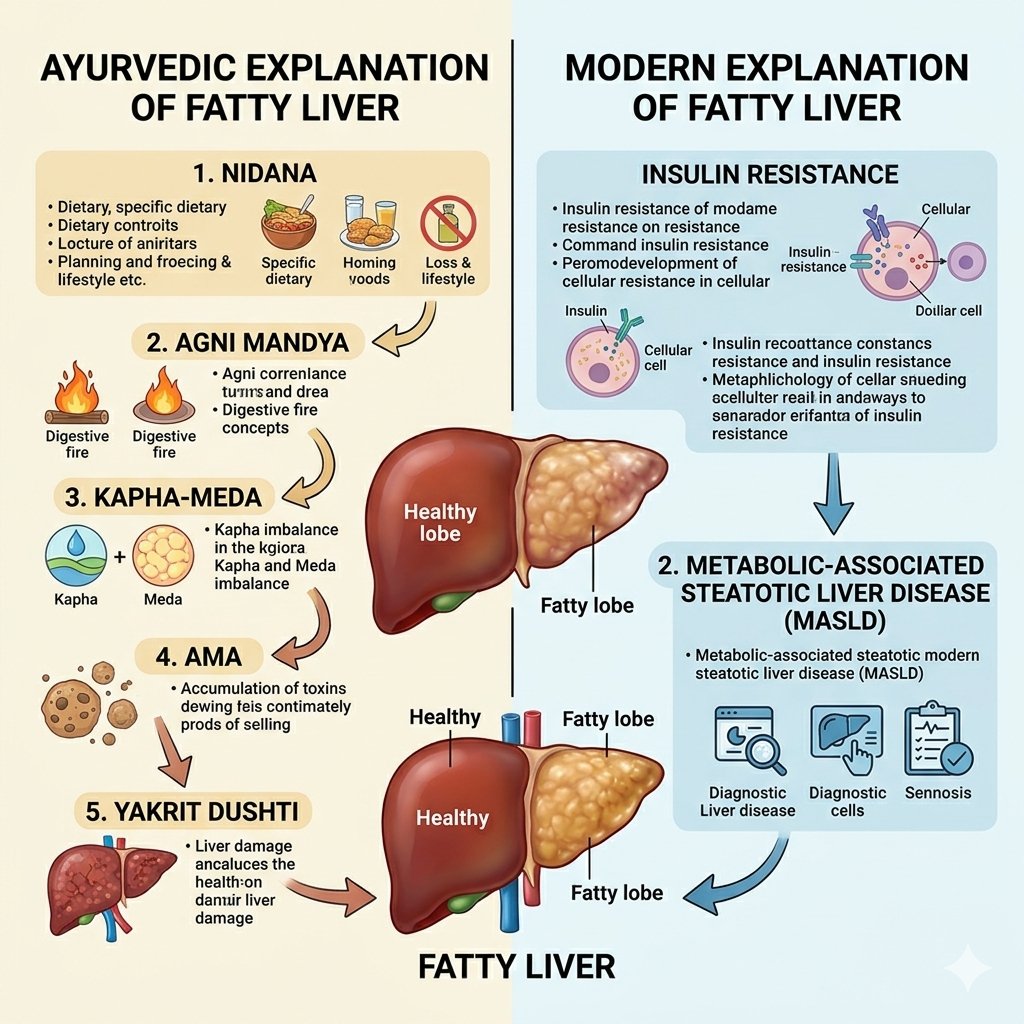
- Nidana (causes): excess sweet, heavy, oily and fried food, eating before the last meal is digested, sleeping in the day, and lack of exercise.
- Samprapti (how it develops): weakened Agni produces Ama. Kapha and Meda accumulate and block the channels (Srotorodha), and fat settles in Yakrit.
- Chikitsa (treatment principle): kindle Agni, clear Ama, reduce Kapha–Meda and protect the liver — mainly through Langhana (lightening) measures such as diet, activity and fasting-like routines.
This view is useful in practice. It explains why a slim person with poor eating habits can still develop fatty liver, and why meal timing and routine matter, not only calories.
Want an Ayurvedic assessment of your fatty liver? Talk to Dr. Monga Medi Clinic.
Ayurveda consultation at ₹800 — clinics in Lajpat Nagar 4, Dwarka Sector 9 and DLF Phase 4 Gurugram, plus online consultations across India, Monday to Sunday, 10 am to 8 pm.
Consultation fee only; tests and medicines, if needed, are extra.
03Does Ayurvedic treatment for fatty liver work? What research shows
Short answerThe parts of Ayurvedic care that change diet, weight and activity clearly work, because these are proven to reduce liver fat. For specific herbs the evidence is still limited. Turmeric/curcumin has the most trials and shows modest falls in liver enzymes, but no herb has been proven to reverse liver scarring.
Here is an honest summary of the evidence, so you can set the right expectations:
| Ayurvedic approach | What research shows | Our view |
|---|---|---|
| Pathya diet & weight loss | Strong evidence: 5–10% weight loss reduces liver fat and inflammation | The foundation of every plan |
| Yoga & daily activity | Exercise reduces liver fat even without weight loss | Essential; built into Dinacharya |
| Turmeric / curcumin (Haridra) | Several small randomised trials and meta-analyses show modest falls in ALT and AST | May help as an add-on, if prescribed |
| Classical liver herbs and formulas | Mostly traditional use, laboratory studies and small case reports | Used selectively, with monitoring |
| Unprescribed “liver detox” products | No good evidence; some products cause liver injury | Avoid |
Researchers who reviewed curcumin trials still call for more studies that measure liver fat and scarring directly. This is why Dr. Monga Medi Clinic uses Ayurveda alongside modern tests, never instead of them.
04Ayurvedic herbs used for fatty liver
Short answerHerbs commonly used in Ayurvedic treatment for fatty liver include Haridra (turmeric), Bhumyamalaki (Phyllanthus), Katuki (Picrorhiza), Triphala and classical formulas such as Arogyavardhini Vati. They should be taken only on prescription, in measured doses, with liver tests checked, because some herbs can cause liver injury.
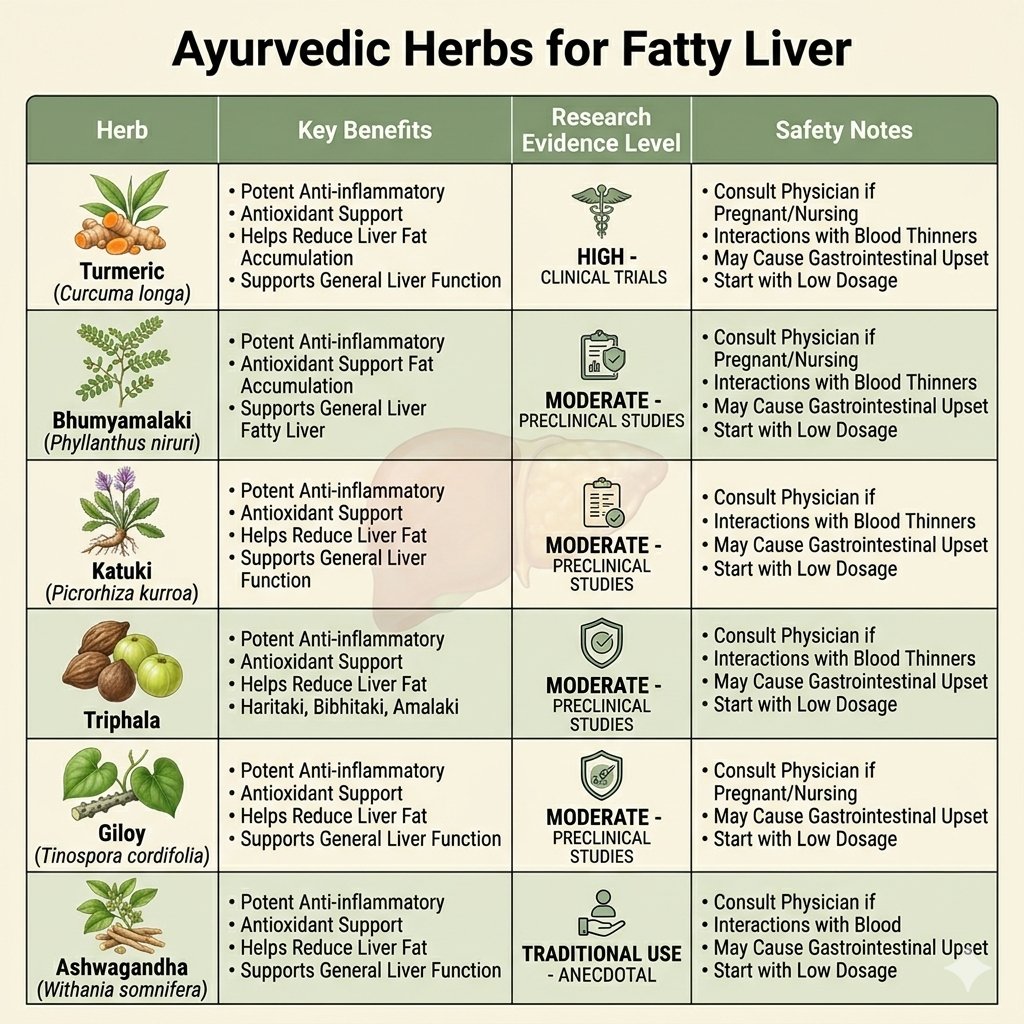
Your Ayurvedic doctor chooses herbs based on your Prakriti (constitution), digestion, weight, sugar levels and liver tests. The same report can lead to different prescriptions for two people.
How we prescribe
- Quality-assured, labelled medicines only
- A defined dose and duration — not open-ended
- LFT checked before starting and at follow-up
- Every other medicine and supplement reviewed
Herbs that need extra caution
- Guduchi (Giloy): an Indian multicentre study linked it to liver injury in some people
- Ashwagandha: rare cases of liver injury reported
- Unlabelled powders or “bhasma”: risk of heavy metals
05Ayurvedic diet (Pathya) for fatty liver
Short answerAn Ayurvedic diet for fatty liver favours light, warm, freshly cooked meals: millets, barley, moong dal, green and bitter vegetables, and buttermilk. It cuts down sweets, maida, fried and heavy food, cold drinks and late dinners. This fits the WHO healthy-diet limits on sugar, salt and fat.
Pathya — favour
- Jowar, bajra, ragi, barley, small portions of rice
- Moong dal, masoor dal, chana
- Lauki, tori, karela, methi, palak, salads
- Takra (buttermilk), amla, seasonal whole fruit
- Spices such as haldi, jeera, saunth in cooking
Apathya — reduce
- Sweets, sugar in chai, jaggery in excess
- Maida, bakery items, namkeen
- Deep-fried food, heavy gravies, excess ghee
- Cold drinks, packaged juices, ice cream
- Alcohol, and large meals late at night
WHO limits to follow
- Free sugars under 10% of daily calories, ideally under 5% (about 6 teaspoons).
- Salt under 5 g a day (one teaspoon), including pickles and papad.
- Fruit and vegetables at least 400 g a day.
- Saturated fat under 10% and trans fat under 1% of calories — avoid vanaspati and reheated frying oil.
Get a personal Pathya diet chart and yoga plan.
Ayurveda consultation at ₹800 — clinics in Lajpat Nagar 4, Dwarka Sector 9 and DLF Phase 4 Gurugram, plus online consultations across India, Monday to Sunday, 10 am to 8 pm.
Consultation fee only; tests and medicines, if needed, are extra.
06Dinacharya and yoga for fatty liver
Short answerA regular daily routine — waking early, a main meal at midday, a light dinner 2–3 hours before bed and 7–8 hours of sleep — plus 150–300 minutes of activity a week supports fatty liver reversal. Yoga, brisk walking and strength exercises all count towards the WHO activity target.
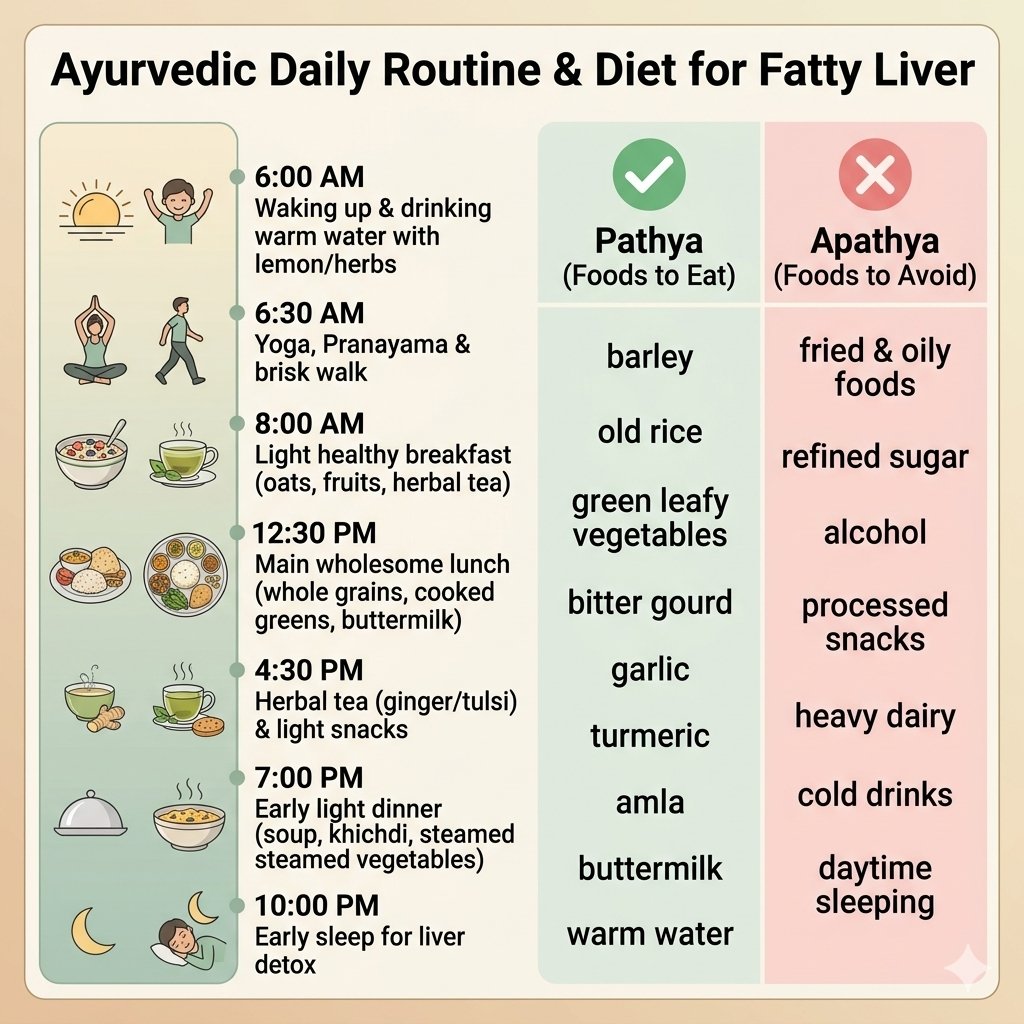
Useful yoga practices include Surya Namaskar, Bhujangasana, Dhanurasana, Ardha Matsyendrasana and Pawanmuktasana, along with Anulom Vilom pranayama for stress. Add brisk walking or cycling, and muscle-strengthening on at least 2 days a week, as WHO advises. Avoid forceful breathing such as Kapalbhati if you have high blood pressure, heart disease, a hernia or are pregnant, unless a trained instructor approves.
07Is Panchakarma needed for fatty liver?
Short answerPanchakarma is not needed for everyone with fatty liver. For selected people with marked Kapha excess and obesity, a supervised procedure such as Virechana (planned purgation) or Udvartana (dry herbal massage) may be advised. It is avoided in advanced liver disease, pregnancy, frailty and some heart and kidney conditions.
Panchakarma should only be done under a qualified Ayurvedic physician, with proper preparation, a recovery diet and medical checks before and after. It is a support to lifestyle change, not a shortcut around it.
08Safety first: herbal does not always mean harmless
Short answerSome herbal products can injure the liver. An Indian multicentre study linked Giloy to liver injury, and rare cases have been reported with ashwagandha. Unregulated products may contain heavy metals or hidden drugs. Take Ayurvedic medicines only on prescription, and get liver tests checked.
Herb-induced liver injury is a real and growing concern, including in India. A study by the Liver Research Club India described patients who developed liver injury after taking Giloy, many of whom had existing liver disease. This is especially important for people with fatty liver, whose livers are already under strain.
- Never self-prescribe herbs from advertisements, social media or online “liver detox” kits.
- Tell your doctor everything you take, including supplements, kadha and home remedies.
- Stop and seek help if you develop yellow eyes, dark urine, itching, severe tiredness or loss of appetite after starting any herb.
- Do not stop prescribed medicines for diabetes, cholesterol or blood pressure without your doctor.
Before you start: a quick readiness check
Ready to start safely? Book your integrated fatty liver consultation.
Ayurveda consultation at ₹800 — clinics in Lajpat Nagar 4, Dwarka Sector 9 and DLF Phase 4 Gurugram, plus online consultations across India, Monday to Sunday, 10 am to 8 pm.
Consultation fee only; tests and medicines, if needed, are extra.
09How long does Ayurvedic treatment for fatty liver take?
Short answerMost people see changes in energy and digestion within weeks, and improvement in weight, liver enzymes and sugar levels in about 3 months. Mild fatty liver often improves within 3–6 months; moderate or severe fatty liver usually needs 6–12 months of steady change.
| When | What to check | On track if… |
|---|---|---|
| Start | Weight, waist, LFT, HbA1c, lipids, FIB-4, ultrasound | Baseline recorded |
| 4–6 weeks | Digestion, energy, sleep, weight | Routine is settling; weight starting to fall |
| 3 months | Weight, waist, LFT, HbA1c | 3–5% weight loss; enzymes falling; LFT safe on herbs |
| 6 months | Ultrasound or FibroScan; full review | Fatty liver grade improving |
If tests do not improve by 3 months, the plan is adjusted. That may mean adding modern medicines for diabetes or weight, or referral to a liver specialist.
10Ayurvedic fatty liver care at Dr. Monga Medi Clinic
Short answerDr. Monga Medi Clinic offers integrated Ayurvedic treatment for fatty liver. Each patient gets an Ayurvedic assessment and modern tests, a personal Pathya diet and yoga plan, prescribed herbs where suitable, diabetes and cholesterol care, and a 3-month review — at three Delhi NCR clinics or online.
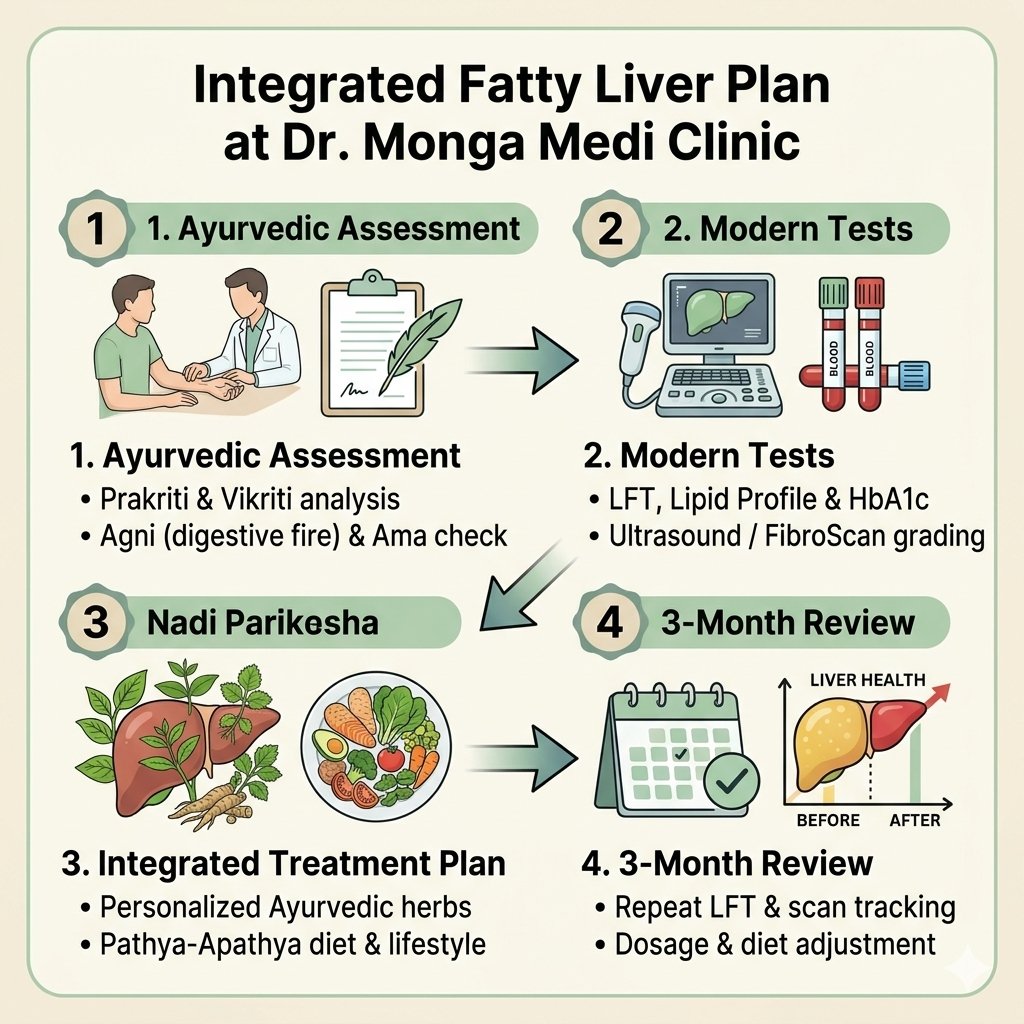
Book in three steps
- Share your reports on WhatsApp at 70424 24269: ultrasound, LFT, sugar and lipid results.
- Choose clinic or online: Lajpat Nagar 4, Dwarka Sector 9, DLF Phase 4 Gurugram, or a video consultation.
- Start your plan with clear targets and a review date.
FAQFrequently asked questions
What is the best Ayurvedic treatment for fatty liver?
The best Ayurvedic treatment for fatty liver is a personalised plan: a Pathya diet, a regular daily routine with yoga and activity, and herbs prescribed after assessment, all monitored with liver and sugar tests. Weight loss and exercise remain the most proven parts of any plan.
Can Ayurveda cure fatty liver completely?
Fatty liver is often reversible, especially in grade 1 and 2, when diet, weight and activity change. Ayurveda can support this process. No herb alone has been proven to cure fatty liver or reverse liver scarring.
Which Ayurvedic medicine is good for fatty liver?
Herbs such as Haridra (turmeric), Bhumyamalaki, Katuki and Triphala, and formulas like Arogyavardhini Vati, are commonly used. The right choice and dose depend on your assessment and liver tests, so take them only on prescription.
Is giloy safe for fatty liver?
Giloy should be used with caution. A multicentre Indian study linked it to liver injury in some people, many of whom had existing liver disease. Take it only if prescribed, with liver tests monitored.
Is turmeric good for fatty liver?
Turmeric (curcumin) has the most research among Ayurvedic herbs for fatty liver. Several small trials show modest falls in liver enzymes. Using haldi in cooking is safe; high-dose supplements should be taken on medical advice.
What should I eat in fatty liver according to Ayurveda?
Favour light, freshly cooked meals: millets, barley, moong dal, green and bitter vegetables, salads, buttermilk and whole fruit. Reduce sweets, maida, fried food, cold drinks, alcohol and heavy late dinners.
Which yoga is best for fatty liver?
Surya Namaskar, Bhujangasana, Dhanurasana, Ardha Matsyendrasana and Pawanmuktasana are commonly advised, with Anulom Vilom for stress. Combine yoga with brisk walking to reach 150–300 minutes of activity a week.
Can I take Ayurvedic medicine with allopathic medicine?
Often yes, but only under a doctor who knows both. Some herbs affect blood sugar or interact with other drugs. Never stop diabetes, cholesterol or blood-pressure medicines on your own.
How long does Ayurvedic treatment for fatty liver take?
Most people see improvement in liver enzymes and weight in about 3 months. Mild fatty liver may improve in 3–6 months; moderate or severe fatty liver usually needs 6–12 months.
What is the consultation fee at Dr. Monga Medi Clinic?
The Ayurveda consultation is ₹800. Tests and medicines, if needed, are extra. Online consultations are available across India.
Start Ayurvedic treatment for fatty liver the safe way — in clinic or online, 7 days a week.
Ayurveda consultation at ₹800 — clinics in Lajpat Nagar 4, Dwarka Sector 9 and DLF Phase 4 Gurugram, plus online consultations across India, Monday to Sunday, 10 am to 8 pm.
Consultation fee only; tests and medicines, if needed, are extra.
Medical sources
- EASL–EASD–EASO Clinical Practice Guidelines on the management of MASLD (2024)
- Curcumin and liver enzymes in NAFLD: systematic review and meta-analysis (Food Sci Nutr, 2024)
- An updated meta-analysis of curcumin in MAFLD (Scientific Reports, 2023)
- Tinospora cordifolia (Giloy)–induced liver injury: multicentre study from India (Hepatology Communications, 2022)
- LiverTox (NIH): Ashwagandha
- Conceptual study of NAFLD and its management in Ayurveda (J Ayurveda Integr Med Sci, 2024)
- WHO: Healthy diet — fact sheet
- WHO guidelines on physical activity and sedentary behaviour: at a glance (2020)
- NCCIH: Ayurvedic medicine — in depth
External links are for further reading and do not replace advice from a qualified health professional.
How this guide was made: written and medically reviewed by the Dr. Monga Medi Clinic medical team, combining classical Ayurvedic principles with current liver guidelines (EASL–EASD–EASO 2024), published research on herbs and herb-induced liver injury, and WHO diet and activity guidance. We review this page at least once a year. Last reviewed 24 Nov 2026.
This guide is for general information and is not a diagnosis or a prescription. Do not start, stop or change any medicine — including herbal or homeopathic remedies — without speaking to a qualified doctor.